The best office chair for pregnancy: a PT's picks for each trimester
Dr. Lena Park, DPT··1 min read
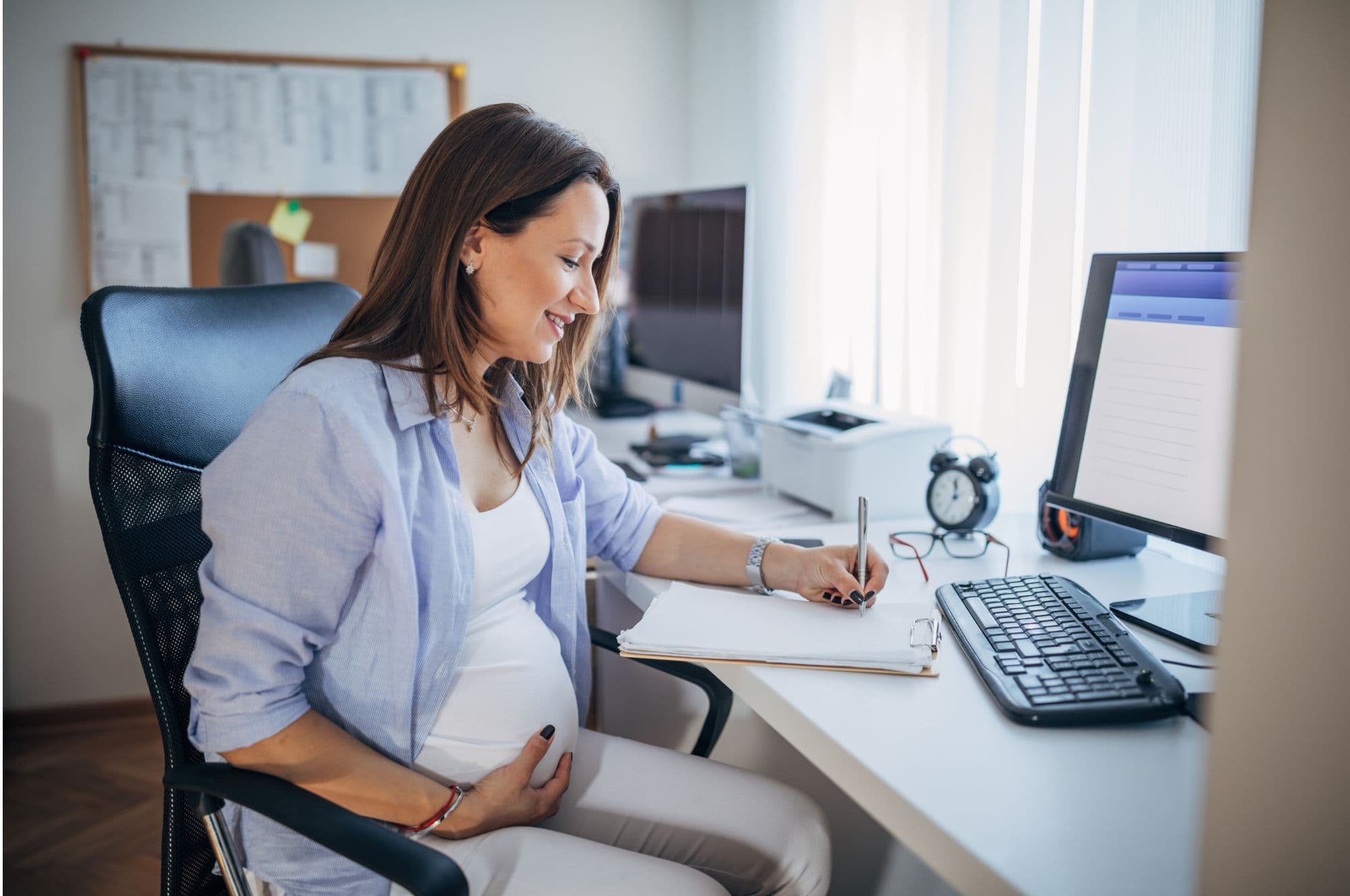
A doctor of physical therapy walks through what changes in your spine each trimester, then names the five chairs that actually accommodate those changes — Aeron, Embody, Steelcase Leap, HAG Capisco, and Sihoo Doro S300.
The short answer.
If you're already in a chair you like, you probably don't need a new one — you need a forward-tilt seat pan, a lumbar that adjusts down to the small of your back (which moves up as the bump grows), and a footrest. That's the truth that most pregnancy-chair roundups bury under affiliate links.
If you do need a chair, the five below cover every budget from roughly $400 to $1,800. They were chosen for one reason: each accommodates the three biomechanical shifts that happen between weeks 12 and 40 — anterior pelvic tilt, increasing lumbar lordosis, and edema in the lower legs. Cute pink mesh chairs from Amazon do not.
What actually changes when you're pregnant and seated.
Three things shift, and all three matter for how a chair fits you:
- Your center of gravity moves forward roughly 2–3 inches by week 30. Your spine compensates with extra lumbar curve (lordosis), which is why a chair with a fixed, shallow lumbar pad starts to feel like a board against your back in the second trimester.
- Relaxin softens your sacroiliac joints from week 10 onward. Long static loads — the hallmark of desk work — become unusually painful. Chairs that allow active sitting (forward tilt, free-float recline) outperform chairs that lock you into one posture.
- Venous return drops. By the third trimester, even short sits trigger ankle and calf swelling. A chair where you can plant both feet flat (or use a footrest with the seat fully lowered) lets the calf muscle pump do its job.
The four chair features that actually matter.
- Forward seat tilt (3°–5°). Tilts the pelvis forward to preserve a neutral lumbar curve as the bump grows.
- Adjustable-height lumbar. The small of your back rises during pregnancy; a fixed lumbar that hits T10 in week 12 hits T6 by week 36.
- Low minimum seat height (≤16"). Lets shorter pregnant users get both feet flat without compressing the popliteal fossa behind the knee.
- Free-float or synchro tilt. Lets you shift weight without re-locking — important when sitting still becomes uncomfortable.

At a glance
Five chairs that fit a pregnant body
Picked for forward tilt, adjustable-height lumbar, low minimum seat height, and free-float recline. Prices in USD as of May 2026.
| Product | Best for | Score | Trial | |
|---|---|---|---|---|
Herman Miller Aeron (size B) | Best overall | |||
Herman Miller Embody | Best for back pain | |||
Steelcase Leap V2 | Best mid-range | |||
HAG Capisco 8106 | Best for short users | |||
Sihoo Doro S300 | Best under $500 |
1. Herman Miller Aeron (size B) — best overall.
The Aeron earns this slot for one feature: PostureFit SL slides up the back of the chair on a vertical track, so the same chair that supported your L4 in the first trimester can support your L1 by the third. Most pregnancy chairs put a lumbar pillow at one fixed height; the Aeron lets you chase the curve as it rises.
The Pellicle mesh matters too. Pregnant women run hotter — basal temperature is up about 0.5°F and skin perfusion increases — and a foam seat that felt fine in January feels swampy in July. The mesh runs cooler than any foam-and-fabric chair we've tested.
The one caveat: most retailers default-recommend size B, but pregnant users in the 5'2"–5'5" range often need size A for the shorter seat depth — long seat pans press into the popliteal fossa once thighs swell.
2. Herman Miller Embody — best for serious back pain.
If you're already in physical therapy for SI joint pain or sciatica, the Embody is the chair I send patients to. The Backfit adjustment rotates the upper backrest independently of the lower, which means you can support a deepening lumbar curve without forcing your shoulders to compensate. No other chair under $3,000 does this.
It's a foam seat, so it runs warmer than the Aeron. But the foam's pixelated structure flexes under shifting weight better than any single-density cushion — useful when you're shifting every five minutes by month seven.
3. Steelcase Leap V2 — best mid-range.
The Leap's LiveBack flexes with the spine instead of forcing the spine to flex against it. For pregnancy this matters because your spine's resting curve changes month to month; a static backrest works against you. The seat slides forward 3 inches, which becomes essential when belly contact with the desk edge forces you to sit further back than you'd like.
Steelcase doesn't market it for pregnancy, but the lower lumbar firmness adjustment is the closest thing to a custom-fit lumbar in this price tier.
4. HAG Capisco 8106 — best for shorter users and active sitting.
The Capisco's saddle seat is the cheat code for pregnancy. A saddle automatically tips the pelvis forward — no lever, no mechanism — which preserves the neutral lumbar curve a conventional flat seat fights. You can perch, sit reverse-facing with the chest against the backrest, or sit conventionally; the chair accommodates all three.
It also adjusts down to a low enough seat height that a 5'1" tester planted both feet flat at month nine without a footrest — uncommon at this seat-cushion thickness.
5. Sihoo Doro S300 — best under $500.
Most chairs under $500 have one fatal flaw for pregnancy: a fixed-height lumbar. The Doro S300's headline feature is a dynamic lumbar that floats vertically as you change posture, which is the closest a budget chair gets to the Aeron's PostureFit. It is not the Aeron — the build is plastic-heavy, the armrests cycle stiffly — but for a chair you may only need for nine months, the value-per-feature is unmatched.
Adjustments that beat any chair upgrade.
If a new chair isn't in the budget, three adjustments to your current chair do more than 80% of what a new chair would:
- Raise the lumbar pad. Every two weeks, slide it up half an inch. By the end of the pregnancy it should be sitting near the bottom of your shoulder blades, not the top of your sacrum.
- Lower the seat height. As ankles swell, lower the seat by half an inch every few weeks until you can plant both feet flat. If you bottom out, add a footrest.
- Add a wedge cushion if your seat doesn't tilt. A 4–6° foam wedge under the back of the seat tilts the pelvis forward and replicates the most useful function of a $1,000 chair for $30.
Buy a new chair if…
- You'll be in this seat 6+ hours a day for the rest of your pregnancy
- Your current chair has a fixed (non-adjustable) lumbar
- Your current chair's lowest seat setting still leaves your feet dangling
- You're already in PT for back, hip, or sciatic pain
- You'll keep working from this chair after the baby arrives
Skip the upgrade if…
- You're in your first trimester and not yet symptomatic
- Your existing chair has adjustable lumbar height and forward tilt
- You work standing more than half the day
- Maternity leave starts in less than 8 weeks
- A wedge cushion plus a footrest hasn't been tried yet
Common questions
Is a kneeling chair good for pregnancy?
No, with one exception. Standard kneeling chairs put pressure on the shins and restrict pelvic mobility — both work against pregnancy biomechanics. The exception is a saddle stool like the HAG Capisco, which preserves the forward-tipped pelvis without the shin pressure.
What about an exercise ball as a desk chair?
Useful in 30-minute bursts, not as a primary chair. The instability strengthens the deep core and encourages micro-movement, but it gives no lumbar support and the constant balance demand is fatiguing by month seven. Use it as one of two or three sitting positions you rotate through, not the only one.
Do I need a special pregnancy cushion?
Most don't. A standard lumbar roll positioned at the small of the back, raised every few weeks, does the same job. The exception is a coccyx-cutout cushion if you're getting tailbone pain in late pregnancy — that's worth the $25.
Should I keep using my chair postpartum?
Yes, but reset every adjustment. Your lumbar curve flattens within a few weeks of delivery and the chair settings that supported pregnancy will feel wrong by week 6 postpartum. Treat it as a fresh fitting.
How long can I sit at a stretch while pregnant?
Standard guidance is no more than 30 minutes static. Stand, walk for 60–90 seconds, and resit. This matters more than which chair you own — DVT risk in the third trimester is real, and the calf-pump activation from short, frequent walks is the single biggest mitigation.
Already have a chair? Start here.
Before you buy anything, work through our chair-fitting checklist — most pregnancy seating problems are solved with three adjustments to a chair you already own.
Written by
Dr. Lena Park, DPTDoctor of Physical Therapy and lead reviewer at Ergoprise. Specializes in workplace posture, cervical-spine load, and the biomechanics of seated work.
Share:
Related Posts
5 Best Genuine Leather Office Chairs in 2026 (Top-Grain & Full-Grain Only)
A clinical take on real leather office chairs — top-grain and full-grain only, ranked by ergonomic frame, leather grade, and 10-year durability.

Best Office Chairs for Coccyx Pain: An OT's 2026 Buying Guide
If sitting flares your tailbone, the chair matters more than the cushion on top of it. Here's the OT-led shortlist of office chairs that actually unload the coccyx.
The Best Office Chairs for Long Hours, Tested by an Ergonomist
We sat in seven ergonomic chairs for 8+ hour workdays. Here is what survived — from a Steelcase Gesture down to a $480 sleeper pick.