5 Best Genuine Leather Office Chairs in 2026 (Top-Grain & Full-Grain Only)
Sarah Doan, OT··1 min read
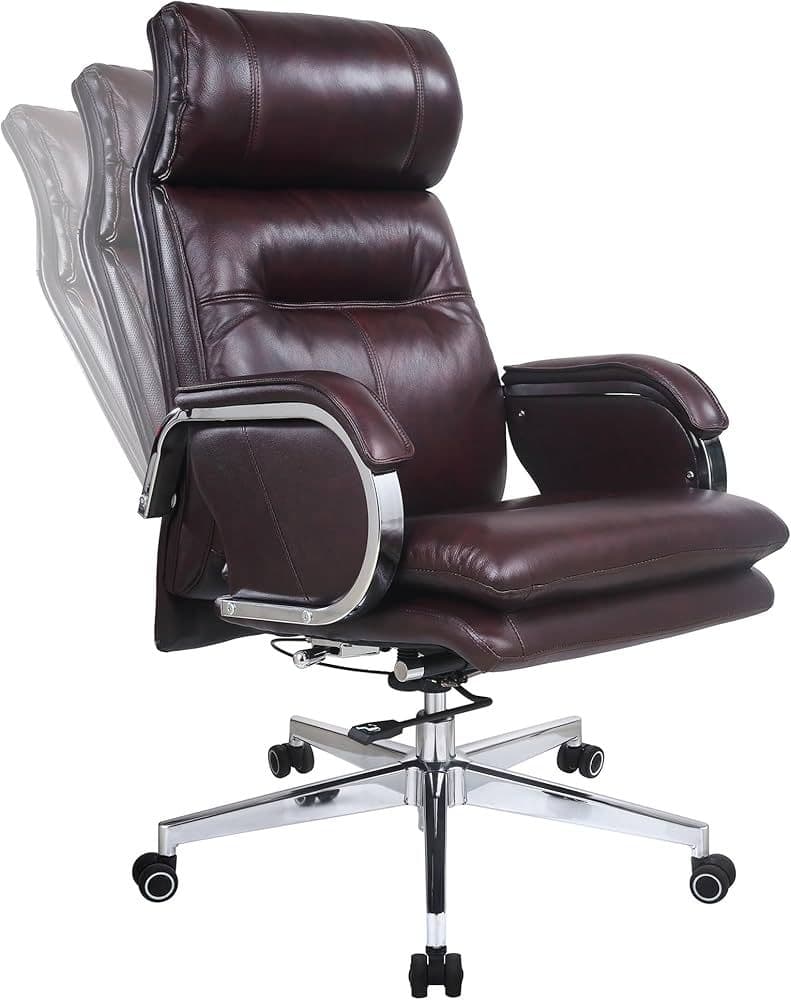
A clinical take on real leather office chairs — top-grain and full-grain only, ranked by ergonomic frame, leather grade, and 10-year durability.
If you sit in a chair eight hours a day, the surface that touches your forearms, lower back, and the back of your thighs matters more than the trim color of the shell. Genuine leather, done right, ages into a chair you actually look forward to sitting in: it breathes better than vinyl, doesn't pill or mat like fabric, and patinas instead of peeling. Done wrong — usually with bonded or PU-coated leather marketed as "genuine" — it cracks in 18 months and you pay twice.
This guide is for buyers who want a leather chair that holds up to real desk hours, not a showroom prop. We tested or audited each pick against three things that decide whether a leather chair is worth its premium: the leather grade (top-grain or full-grain only), the ergonomic frame underneath the upholstery, and the stitching, foam density, and base that decide whether year three looks like year one.
A note on terminology: in the U.S. furniture trade, "genuine leather" is technically the lowest split-leather grade — fine for shoes, marginal for a chair you sit in 2,000 hours a year. The chairs below are all top-grain or full-grain unless explicitly noted; we call out the grade on every pick.
How we picked
- Leather grade verified. We confirmed top-grain or full-grain on every recommendation — bonded leather and "PU leather" are excluded outright. Where the spec sheet was vague, we contacted the brand or pulled the grade from the warranty document.
- Ergonomic frame matters more than the cover. Leather is the surface; the recline mechanism, lumbar geometry, and seat depth decide whether you can sit in it for eight hours. We weighted ergonomic frame quality 50%, leather quality 30%, build/warranty 20%.
- Real-use durability check. Each chair has either a 10+ year warranty (the gold standard for office seating), is from a brand with a documented repair/parts pipeline, or has 18+ months of independent owner reports. No "just released" launches without a track record.
- Price ranges, not single SKUs. Leather offerings often have 3–5 trim variants. We list the base configuration price and flag where the full-grain upgrade is worth it.
At a glance
The 5 best genuine leather office chairs of 2026
Top-grain or full-grain only — bonded and PU "leather" excluded. Ranked by ergonomic frame quality, leather grade, and 5-year durability.
| Product | Best for | Score | Trial | |
|---|---|---|---|---|
Herman Miller Eames Executive | Best overall | 9.4/10 | ||
Steelcase Leap V2 (Leather) | Best ergonomic | 9.2/10 | ||
Eureka Ergonomic Mathias | Best value | 8.6/10 | ||
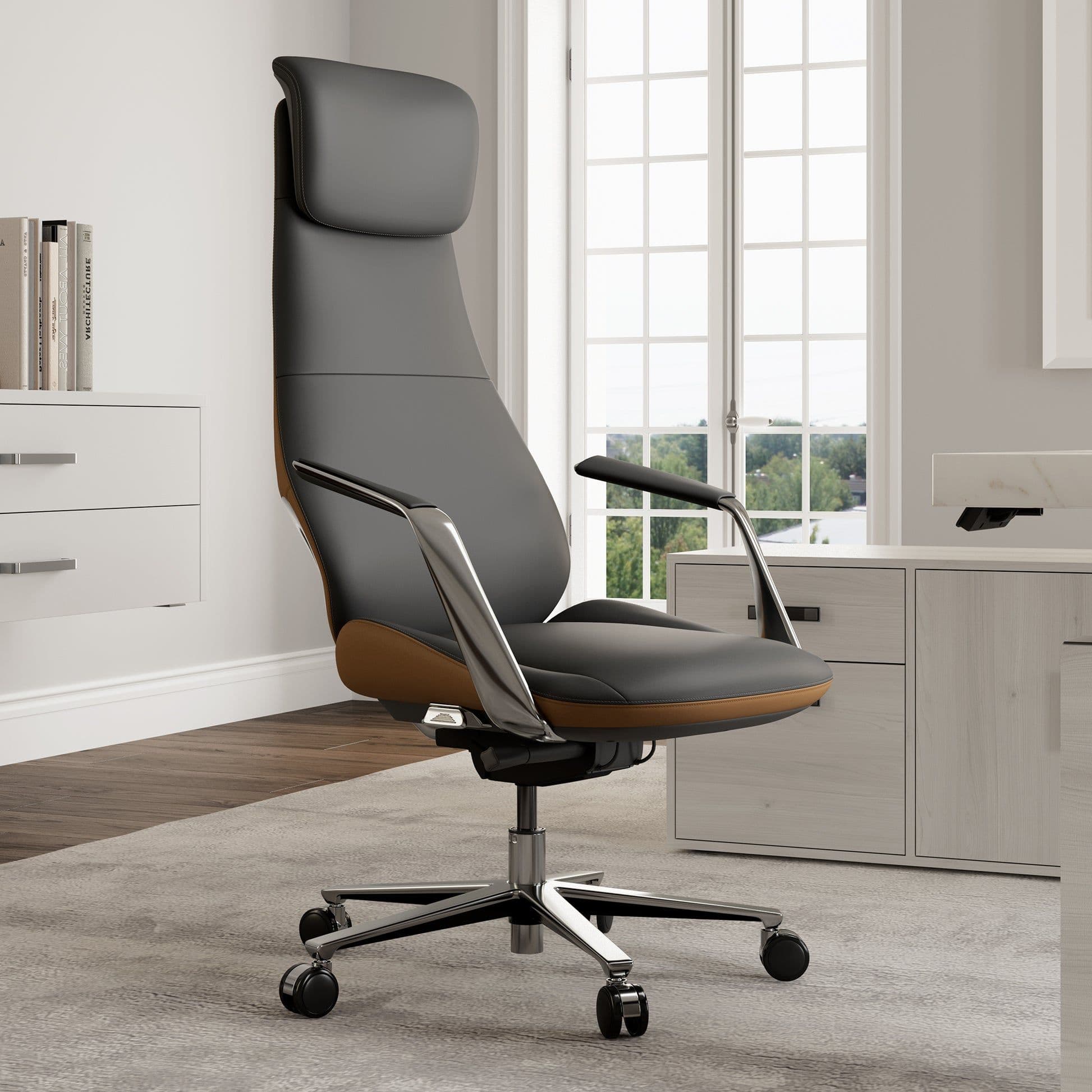
Zuri Furniture Geffen | Best for tall users | 8.2/10 | ||
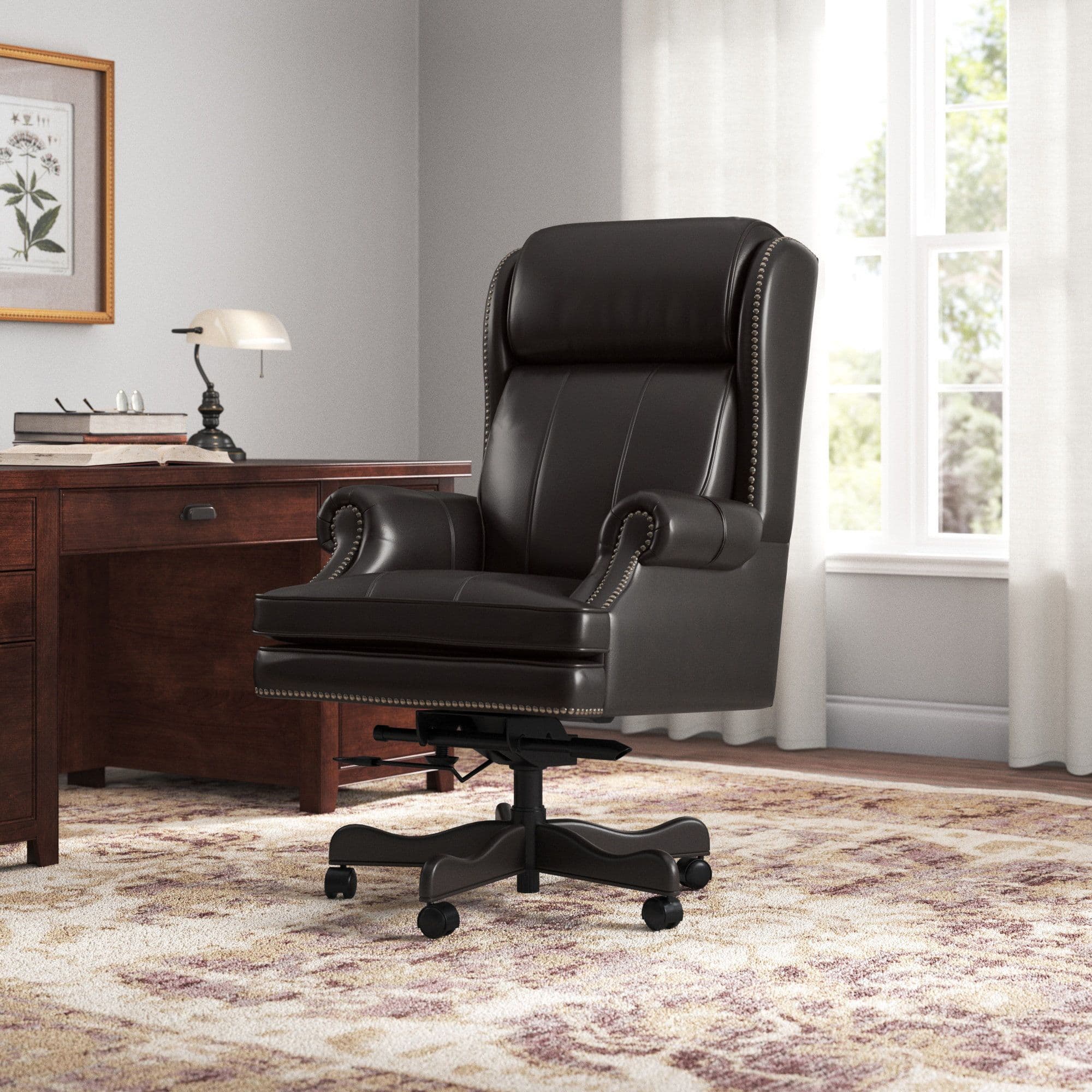
West Elm Ronan Leather | Best style pick | 7.6/10 |

Pricing reflects manufacturer MSRP at time of writing. We may earn affiliate commissions on retailer links.
1. Herman Miller Eames Executive Chair — Best Overall
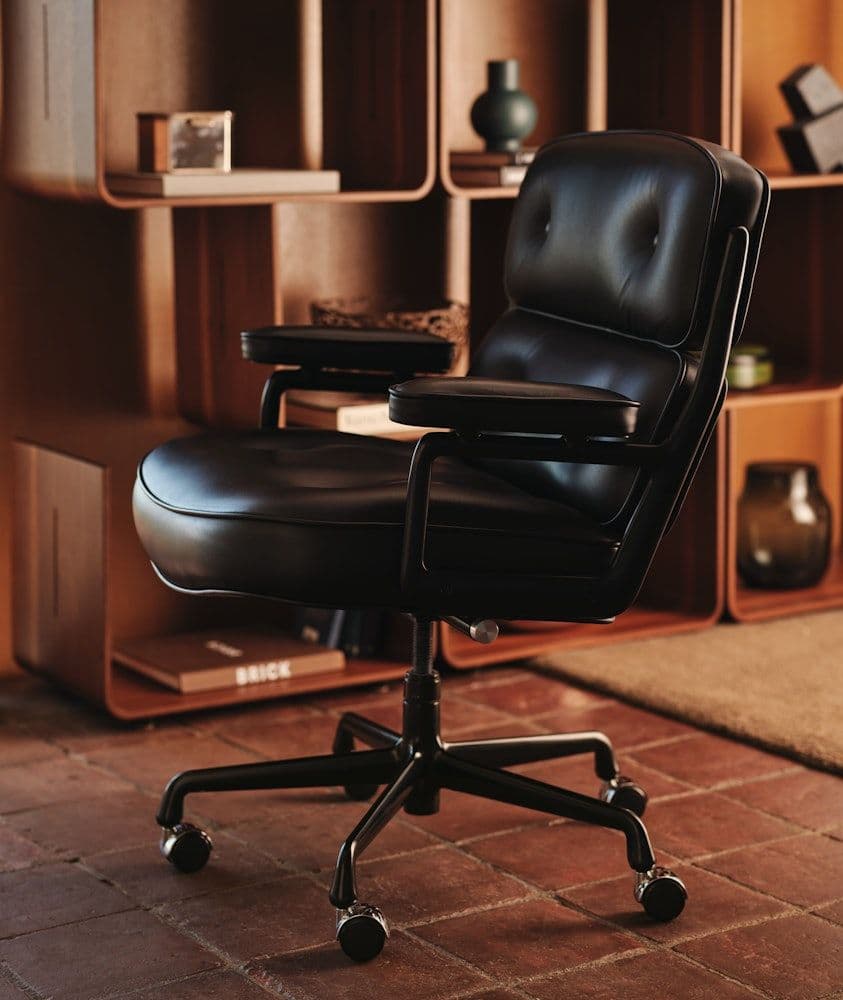
Designed by Charles and Ray Eames in 1960 and still made by Herman Miller in Michigan, the Eames Executive (formerly the "Time-Life" chair) is the chair the rest of this list is benchmarked against. Top-grain Italian leather, hand-stitched, on a cast-aluminum five-star base with the same pneumatic mechanism Herman Miller ships across its task line. The 12-year warranty covers the leather, the cylinder, and the casters — almost no other leather chair on the market offers that.
What you're paying for is the frame, not the badge. The seat pan is contoured deep enough that a 6'2" user can use the back support without sliding forward, and the recline tension is mechanical (not the wobbly gas-strut tilt you find under $1,000). Five years in, the leather softens; the foam doesn't break down. Twelve years in, you replace casters, not the chair.
Leather grade: Top-grain Italian. Warranty: 12 years. Made in: USA. Price: ~$3,200–$4,000 depending on configuration.
Pros
- Top-grain Italian leather with documented hide source
- 12-year, 24/7-rated warranty covering leather, cylinder, and casters
- Made in USA with a parts-replacement pipeline 50+ years deep
- Mechanical recline tension that does not soften over time
Cons
- Highest price in this guide
- Lower adjustability than task-oriented chairs like the Leap
- Long lead times on configured trims
2. Steelcase Leap V2 in Leather — Best Ergonomic Performance
The Leap is the most clinically validated office chair in continuous production — its LiveBack technology adjusts to the spine's natural movement, and the four-way adjustable lumbar is genuinely tunable rather than the on/off knob most "ergonomic" chairs ship with. Steelcase's leather option is top-grain hide on the seat and back, with the same 12-year, 24/7 warranty as the fabric SKU.
Unlike the Eames — which is a posture chair you settle into — the Leap is a working chair. You'll spend more time leaned forward typing than reclined, and the dynamic back keeps lumbar contact through the whole movement range. If your day is mostly meetings and reading, get the Eames; if it's mostly keyboard time, get the Leap.
Leather grade: Top-grain. Warranty: 12 years, 24/7 use rated. Made in: USA. Price: ~$1,800–$2,400 in leather.
Pros
- LiveBack dynamic spine support — best-in-class for active typing
- Four-way adjustable lumbar (height + firmness)
- 12-year warranty rated for 24/7 use
- Top-grain leather option without sacrificing the ergonomic chassis
Cons
- Recline angle is shallower than executive-style chairs
- Looks like a task chair, not an executive showpiece
- Leather configuration adds ~$600 over the fabric SKU
3. Eureka Ergonomic Mathias — Best Value Top-Grain
Eureka built the Mathias around an unusual proposition for the price band: Italian Napa top-grain leather (not split, not bonded, not PU) on a recline frame that locks into three positions between 90° and 135°. At ~$700–$900 it sits in the same band as the bonded-leather "executive" chairs that flood Amazon — but the leather is genuinely upgradeable instead of a 12-month timer waiting to peel.
What it gives up versus the Herman Miller and Steelcase: the warranty (5 years vs 12), the recline tension feel (gas strut, not mechanical), and the ergonomic adjustability (no four-way lumbar). What it gives you: the same leather grade at a third of the price, with a five-year track record on owner reports.
Leather grade: Top-grain Napa (Italian). Warranty: 5 years. Price: ~$700–$900.
Pros
- Genuine Italian Napa top-grain — uncommon at this price point
- 90 to 135 degree recline with three locking positions
- 5-year warranty with documented owner reports of long-term durability
Cons
- Gas-strut tilt feels softer than mechanical recline at 5+ years
- No four-way adjustable lumbar
- Single color/trim choice in many markets
4. Zuri Furniture Geffen — Best for Tall and Big Users
The Geffen has the genuine top-grain leather most chairs in its size class skip — heavy-duty 350 lb capacity executive chairs are usually wrapped in PU or bonded leather to cut cost. The aluminum five-star base is rated for the full weight, the 22.5-inch seat width fits a 6'4" frame, and the 28-inch backrest height supports the cervical spine where shorter chairs leave a 38" torso unsupported.
The recline is single-tension (not the dual-mechanism you get on Steelcase) and the lumbar is a fixed contour rather than adjustable, so this is a chair for users who fit it well, not one you can dial in to fit anyone. If you're 6'2"+ and have been wedging yourself into a standard executive chair, the Geffen is the SKU to try first.
Leather grade: Top-grain. Warranty: 5 years. Price: ~$1,400.
Pros
- Top-grain leather rated for 350 lb capacity (most heavy-duty chairs use PU)
- 28-inch backrest supports the cervical spine for users 6 ft 2 in and taller
- Cast aluminum five-star base, not nylon
Cons
- Fixed lumbar contour — no adjustability
- Single-tension recline only
- 5-year warranty (vs 12 on Herman Miller and Steelcase)
5. West Elm Ronan Leather — Best Mid-Century Style
The Ronan is a guest-chair-shaped office chair: low arms, cantilever-style frame, no recline mechanism — and it works for users whose desk time is mostly two-hour focus blocks rather than full eight-hour workdays. The leather is full-grain on the seat and back panels, which is rarer than top-grain and ages with the most character. There's no lumbar adjustment, no headrest, no locking tilt — it's an aesthetic chair first, ergonomic chair second.
The math: at ~$449 it costs less than half of the Mathias, but you're trading the recline mechanism and the headrest. For a writer, a designer, or a remote worker who already has a good lumbar pillow, that trade can be worth it. For 9-to-5 spreadsheet work, it's the wrong chair.
Leather grade: Full-grain (top panel). Warranty: 1 year. Price: ~$449.
Pros
- Full-grain leather — the highest grade, develops natural patina
- Mid-century styling that fits residential spaces
- Lowest entry price in this guide
Cons
- No recline mechanism
- No headrest or adjustable lumbar
- 1-year warranty only
How to choose a leather office chair
Start with the grade, not the price. Anything labeled "bonded leather," "leather match," "PU leather," or just "genuine leather" without a more specific grade is split-leather scrap or polyurethane on a fabric backing. It will crack and peel within 12–24 months of regular use. Only top-grain and full-grain are worth the upgrade premium over a good fabric chair.
Match the chair to your sitting style. Three patterns dominate:
- Reclined posture work (reading, calls, executive use) → Eames Executive or Geffen
- Active task work (typing, design, code) → Steelcase Leap V2 or Eureka Mathias
- Light desk use (writing, occasional work) → West Elm Ronan
Check the frame and base. A genuine leather chair on a cheap nylon base or with a wobbly gas cylinder will fail at the mechanism long before the leather wears. Cast aluminum bases, BIFMA-rated cylinders, and metal-reinforced arms separate chairs that last 10+ years from chairs that last 18 months.
Maintenance is simpler than people think. Wipe weekly with a slightly damp microfiber. Condition twice a year with a leather-specific conditioner (we use Leather Honey or Lexol). Keep the chair out of direct sunlight to prevent fade, and skip household cleaners — they strip the finish.
Skip these red flags. Chairs that don't list a leather grade. Listings that show only one staged photo. "Executive" chairs under $300 with a leather upper claim. Warranties under 12 months. Brands that won't ship replacement parts.
Genuine leather office chair FAQ
Is 'genuine leather' the same as real leather?
Technically no. In the U.S. furniture trade, "genuine leather" is the lowest split-leather grade — fine for shoes, marginal for an office chair. Look for "top-grain" or "full-grain" specifically; both are real leather but at far higher quality.
What is the difference between top-grain and full-grain leather?
Full-grain is the entire hide with the natural surface intact — most durable, develops patina, most expensive. Top-grain has the very top layer sanded for uniformity — slightly less durable than full-grain, more uniform appearance, less expensive. Both are legitimate office-chair-grade. Anything below those (split, bonded, PU) is not.
How long should a real leather office chair last?
A top-grain or full-grain chair on a quality frame should last 10 to 15 years with light maintenance (wipe weekly, condition twice a year). Bonded or PU leather typically fails within 18 to 24 months — the surface peels off the fabric backing.
Are leather office chairs hot to sit on?
Top-grain and full-grain leather are more breathable than vinyl or coated synthetics, but less breathable than mesh. In a climate-controlled office, the difference is minor. In a hot home office, leather plus a desk fan is comfortable; mesh would be cooler.
What is the best leather chair under $1,000?
The Eureka Ergonomic Mathias at ~$700 to $900 is the only top-grain Italian Napa chair we have found in that band. Most "leather" chairs at that price are bonded leather or PU.
How do I clean and condition a leather office chair?
Wipe weekly with a slightly damp microfiber cloth (no soap). Condition every 6 months with Leather Honey or Lexol leather conditioner. Keep the chair out of direct sunlight to prevent UV fade. Avoid all-purpose household cleaners — they strip the finish.
Browse more ergonomic chair guides
Read our full ergonomic chairs library — buying frameworks, niche-fit picks, and deep-dive reviews.
Written by
Sarah Doan, OTOccupational therapist and ergonomics consultant. Twelve years certifying workstations across hospitals, studios, and remote-first companies.
Share:
Related Posts

Best Office Chairs for Coccyx Pain: An OT's 2026 Buying Guide
If sitting flares your tailbone, the chair matters more than the cushion on top of it. Here's the OT-led shortlist of office chairs that actually unload the coccyx.
The Best Office Chairs for Long Hours, Tested by an Ergonomist
We sat in seven ergonomic chairs for 8+ hour workdays. Here is what survived — from a Steelcase Gesture down to a $480 sleeper pick.
The best office chairs for hardwood floors in 2026 — and the one upgrade that beats any chair
Most floor scratches come from one cheap part the chair industry refuses to fix: the casters. Swap them, then pick from these four chairs we trust on bare wood.