
Standard mattress sizes range from Twin to California King. Compare dimensions, see who each size fits best, and learn how to choose the right one for your room.
Mattress size is one of the most consequential decisions you make when buying a bed. The right size determines whether you wake up rested or with a partner's elbow in your ribs, whether your bedroom feels like a sanctuary or a storage closet, and whether your sheets actually fit.
Below is a plain-English guide to every standard mattress size sold in the U.S., along with the niche specialty sizes (RV, split, Olympic Queen, super single) that solve specific problems. Dimensions are drawn from consensus across major mattress retailers and editorial guides, including Sleep Foundation, Mattress Firm, and BedInABox.
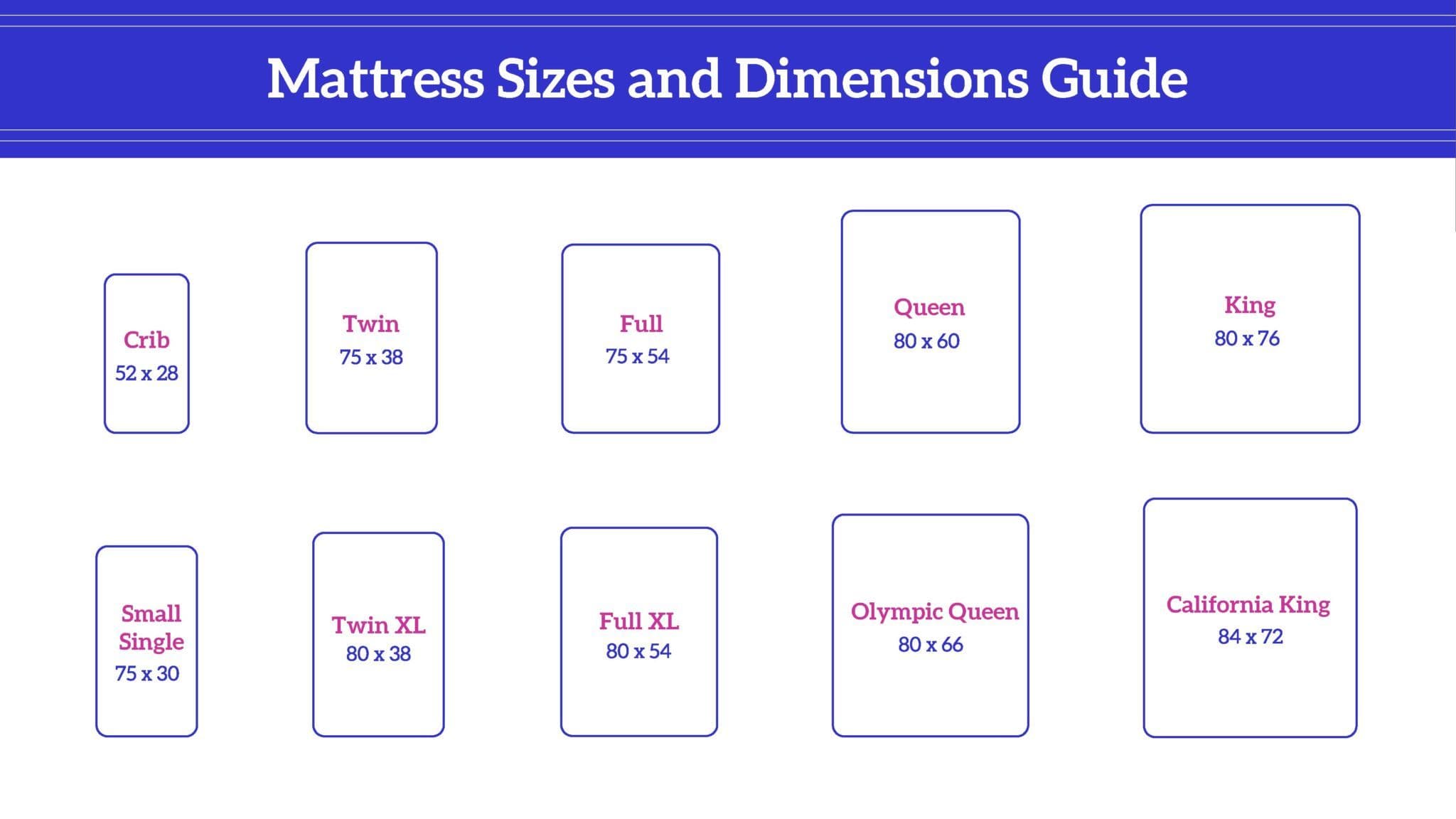
There are six standard sizes in the U.S. Width is listed first, then length.
Twin: 38" × 75" — the smallest standard size. Best for kids, teens, single adults in compact rooms, and bunk beds.
Twin XL: 38" × 80" — same width as Twin, five inches longer. The standard college dorm size and a fit for tall single sleepers.
Full (Double): 54" × 75" — a roomier solo bed and the budget option for couples in tight spaces. Each sleeper gets only ~27" of width, narrower than a baby's crib width per person.
Queen: 60" × 80" — the most popular mattress size in America. Comfortable for couples, fits in most master bedrooms, and has the widest selection of bedding and frames.
King: 76" × 80" — the widest standard size. Each sleeper gets the same 38" of personal space as a Twin. Ideal for couples who co-sleep with kids or pets.
California King: 72" × 84" — four inches narrower than a King but four inches longer. Designed for tall sleepers (6′2”+) and long, narrow bedrooms.

If two adults will share the bed, start at Queen. Queen is the U.S. default for a reason: 30" of width per sleeper is the threshold most people stop feeling crowded, and it fits in 10' × 10' bedrooms with room to walk around.
Move up to King when at least one of these is true: a partner who moves a lot, kids or pets join the bed, or one sleeper is over 6′0”. King gives each adult the same elbow room as a Twin sleeper has solo.
Choose California King over standard King only if at least one sleeper is taller than the bed (King is 80" long; Cal King is 84") or your bedroom is long and narrow. Bedding for Cal King is harder to find and usually pricier than King.
Twin is the right answer for kids' rooms, bunk beds, and small guest rooms. It's also the cheapest entry point for a quality mattress.
Twin XL is what to buy if the sleeper is over 5′9” or anticipates being taller (a teen who is still growing). The five extra inches of length matter more than people expect once they hang off the end of a Twin.
Full works as a solo upgrade when there's room — it gives an individual sleeper the freedom to sprawl — but it's a tight fit for two adults except as an emergency or guest-room option.
Industry guidance is to leave at least 24–30 inches of walking space on each side of the bed plus 36 inches at the foot. As a rough sizing rule: a Twin fits a 7×10 room, a Full needs 9×10, a Queen wants 10×10 or larger, and a King fits comfortably only at 12×12 or above.
Don't forget to measure doorways, hallways, and stair turns. A King mattress is 76 inches wide — plenty of homes can't actually deliver one through a tight stairwell without a split-king workaround.
If you're over 6 feet tall, anything shorter than 80 inches will feel cramped — so Twin XL, Queen, King, or California King are your real options. Side sleepers benefit from extra width because they take up more horizontal space than back or stomach sleepers. Couples with a co-sleeping child or large dog should bump up one size from what they'd buy as a couple alone.
If you already own a frame, your size is decided for you. If you're buying a new frame, double-check that it's listed for the size you want — some platform beds are marketed as "queen-or-king" with conversion kits and not all conversions are equal. Bedding (sheets, mattress pads, duvets) is sized to the mattress, not the frame, so the size you choose locks in what you can buy at every linens store from now on.
If you've never slept on the size you're buying, lie down on a floor model in a showroom — ideally with whoever else will share the bed. Five minutes lying on a Queen versus a King is more informative than any chart, and most online mattress brands offer 100-night trials so a wrong-sized purchase isn't permanent.
Split King and Split Cal King: two Twin XL mattresses laid side by side under one comforter. Sold for couples with very different firmness preferences, and the only realistic option for adjustable bases that move each side independently.
Olympic Queen: 66" × 80". Six inches wider than a standard Queen. A reasonable middle ground for couples whose room is too small for a King but who feel cramped on a Queen. Bedding is rare — plan to special-order sheets.
Short Queen / RV Queen: 60" × 75". The standard Queen-equivalent inside RVs, campers, and trailers. Five inches shorter than a residential Queen, so don't try to retrofit RV sheets onto a home bed or vice versa.
Full XL: 54" × 80". A Full's width with a Twin XL's length — a niche size used in some apartment lofts and group housing.
Texas, Wyoming, and Alaskan King: oversized custom kings (98” × 80”, 84” × 84”, and 108” × 108” respectively). Custom-built and custom-priced — most buyers will never need one.
Six standard sizes are sold in the U.S.: Twin (38" x 75"), Twin XL (38" x 80"), Full (54" x 75"), Queen (60" x 80"), King (76" x 80"), and California King (72" x 84"). Specialty sizes include Split King, Olympic Queen, Short Queen for RVs, Full XL, and oversized customs like Texas King.
Queen (60" x 80") is the most popular mattress size in the U.S. It's wide enough for couples, fits in most master bedrooms, and has the largest selection of frames and bedding of any size.
A standard King is wider but shorter (76" x 80"); a California King is narrower but longer (72" x 84"). Choose California King if either sleeper is over 6'2" or your bedroom is long and narrow rather than square. Otherwise, the standard King's extra width is more useful.
Technically yes, but tightly. A Full gives each sleeper roughly 27 inches of width, less than a Twin per person. It works for short stays, occasional guests, or couples in studio apartments, but most couples size up to a Queen for daily use.
Plan for at least 24-30 inches of walking space on each side of the bed and about 36 inches at the foot. As a rough rule, a Queen needs a 10' x 10' room minimum and a King is comfortable only in 12' x 12' or larger bedrooms.
No. RV beds use shortened versions: an RV Queen is 60" x 75" instead of the residential 60" x 80", and RV Twin and Full sizes are similarly trimmed. Standard residential sheets won't fit an RV mattress correctly.
Visit a Banner Mattress showroom to lie down on every standard size in person and let our team match you with a fit for your room and sleep style.

Written by
Banner Mattress EditorialThe Banner Mattress editorial team is a collective of sleep experts, mattress design researchers, production specialists, and industry veterans publishing independent reviews and sleep guidance since 2018. We've personally tested over 1,000 mattresses and 3,000+ pillows, sheets, and sleep accessories — every recommendation is based on hands-on evaluation in our review lab, not vendor talking points. Our work covers brand reviews (Saatva, Helix, Nectar, Purple, Tempurpedic, and more), buying guides by size and firmness, comparisons, and science-backed sleep health advice. Affiliate links may earn us a commission, but never influence which products we recommend.
 Mattress Guides
Pick a bedside reading lamp that protects your eyes and your sleep: target 2700-3000K, 400-800 lumens, a directional shade at eye level, and a dimmer or smart bulb so a midnight wake-up doesn't blast you awake.
 Mattress Guides
Whether you actually need a box spring depends on your mattress and bed frame. Here's how to pick the right type, height, and size — or skip it entirely.
 Mattress Guides
Mattress firmness is rated on a 1-to-10 scale and is one of the biggest drivers of sleep quality. Here's how to match the right level to your sleep position, body weight, and pain points.